
Officials continue to warn people to properly handle and cook poultry amidst an ongoing three-year Salmonella Reading outbreak that has sickened more than 120 people in Canada with the same strain of the bacterium that hit people in 43 U.S. states.
At least 16 more people in Canada were confirmed as patients in the outbreak there in November. The Public Health Agency of Canada expects additional sick people to be identified because it is taking between five and six weeks for confirmation testing and reporting for most cases.
Although the U.S. Centers for Disease Control and Prevention declared the outbreak over in April, the agency continues to monitor the multi-state PulseNet system for additional ill people. In the U.S. the outbreak ran from November 2017 through the end of March this year.
Of the 126 confirmed patients in Canada and the 358 in the United States, one died in each country. Hospitalization rates have been higher than usual for Salmonella infections, with 38 in Canada and 133 in the United States having been admitted for in-patient care.
“The Public Health Agency of Canada is not advising that consumers avoid eating properly cooked turkey or chicken products, nor is it advising retailers to stop selling raw turkey and raw chicken products. The Canadian Food Inspection Agency has not issued any food recall warnings related to this outbreak,” according to the update Wednesday from Canadian public health officials.
In the U.S. several human and pet foods were recalled, including some Jennie-O brand turkey products and pet food sold under the Woody’s and Raws for Paws brands.
Canadian officials have come to similar conclusions as their U.S. counterparts in terms of root sources of the Salmonella.
“Based on the investigation findings to date, exposure to raw turkey and raw chicken products has been identified as the likely source of the outbreak. Many of the individuals who became sick reported eating different types of turkey and chicken products before their illnesses occurred,” Canadian public officials report.
“Through the use of a laboratory method called whole genome sequencing, some Salmonella illnesses dating back to 2017 were identified to have the same genetic strain as the illnesses that occurred in late 2018. The majority of illnesses under investigation occurred between October 2018 and November 2019.”
The province of Alberta has been hardest hit in the outbreak, with 44 confirmed patients. Other provincial counts are: British Columbia with 31, Saskatchewan with 8, Manitoba with 24, Ontario with 8, Quebec with 2, New Brunswick with 1, Prince Edward Island with 1, Northwest Territories with 1, and Nunavut with 6.
Canada’s public health agency reports that despite their country’s patients being infected by the same strain as patients in the United States none of the recalled U.S. products were exported to Canada.
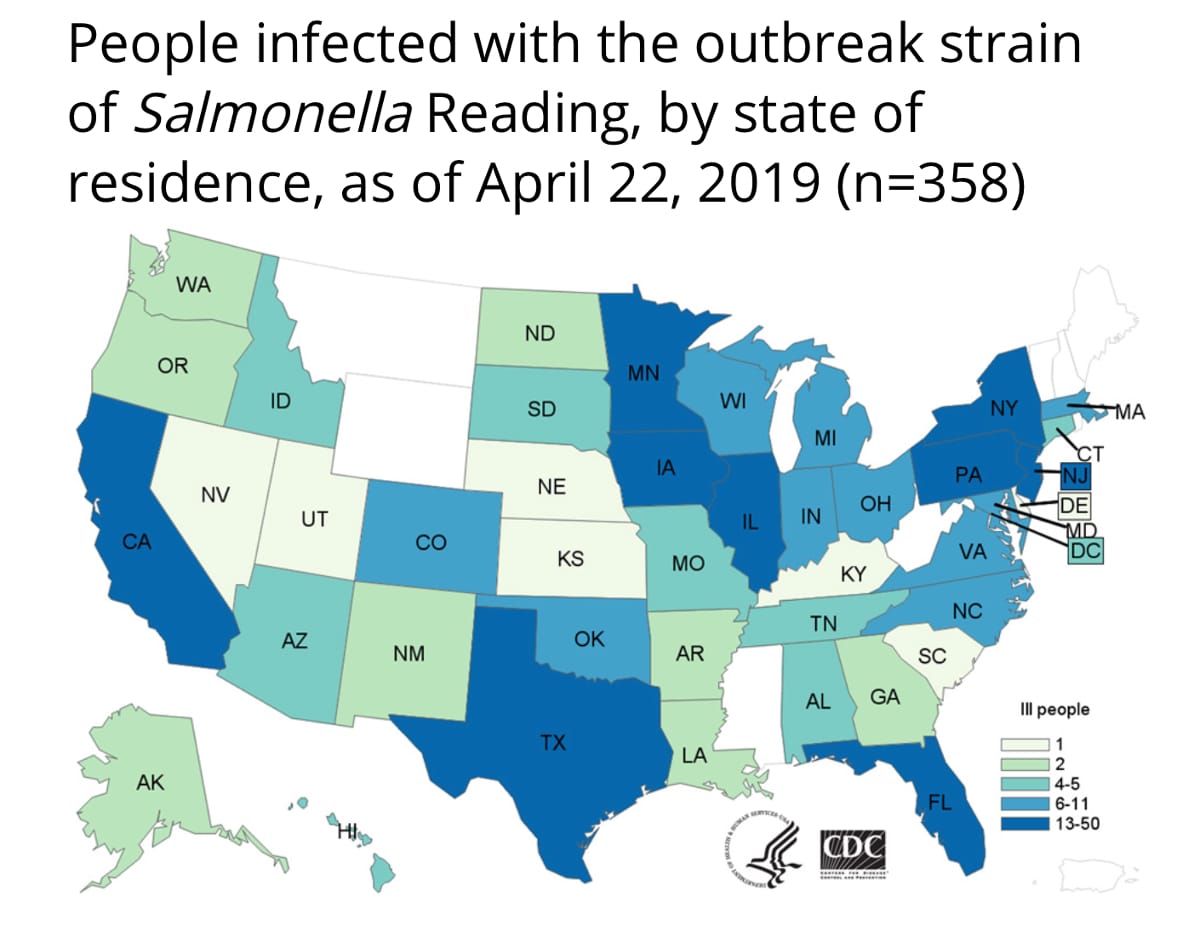
Officials in the United States reported the outbreak strain of Salmonella Reading was identified in samples taken from raw turkey products, raw turkey pet food, and live turkeys. The CDC investigation, which included work by state health departments and the U.S. Department of Agriculture, showed widespread contamination through the turkey industry. Industry groups have promised to review mitigation procedures.
“Ill people reported buying many different brands of raw turkey products from multiple stores. Also, 4 of the 200 ill people interviewed became sick after pets in their home ate. Five of the 200 ill people interviewed worked in a facility that raises or processes turkeys, or lived with someone who did. In February 2019, 47 people became ill after eating turkey that was not handled properly at an event in Iowa,” according to the CDC.
“The outbreak strain was also identified in samples from raw turkey products from 24 slaughter and 14 processing establishments.”
Consumers are responsible for properly handling and cooking poultry to avoid cross contamination and undercooking, according to Canadian and U.S. officials.
“This outbreak is a reminder of the importance of using safe food handling practices if you are preparing, cooking, cleaning or storing raw turkey and raw chicken products. These raw products can have bacteria that can easily be spread around food preparation areas and can make you sick if safe food-handling practices are not properly followed,” the new Canadian warning states.
The Public Health Agency of Canada posted the following tips to ensure food safety with poultry:
- Always wash your hands before and after you touch raw turkey and raw chicken. Wash with soap and warm water for at least 20 seconds. Use an alcohol-based hand rub if soap and water are not available.
- Always cook turkey and chicken products to a safe internal temperature that has been checked using a digital thermometer.
- Turkey and chicken breasts, as well as ground poultry, including turkey and chicken burgers, should always be cooked to an internal temperature of 74 degrees C (165 degrees F) to kill any harmful bacteria. Whole turkey and chicken should be cooked to an internal temperature of 82 degrees C (180 degrees F).
- Leftovers should be reheated to 74 degrees C (165 degrees F). Use a digital food thermometer to check, and place it in the thickest part of the food.
- Thaw frozen raw turkey and raw chicken in the fridge. Thawing raw turkey and raw chicken at room temperature can allow bacteria to grow.
- Never rinse raw turkey or raw chicken before cooking it because the bacteria can spread wherever the water splashes.
- Use a separate plate, cutting board, utensils and kitchen tools when preparing raw turkey and raw chicken.
- Clean everything that has come in contact with raw turkey or raw chicken with a kitchen cleaner or bleach solution and then rinse with water.
- Kitchen cleaner (follow the instructions on the container)
- Bleach solution (5 mL household bleach to 750 mL of water)
- Keep raw turkey and raw chicken away from other food while shopping, storing, repackaging, cooking and serving foods.
- If you have been diagnosed with a Salmonella infection or any other gastrointestinal illness, do not cook food for other people.
- Do not feed raw ground turkey or raw ground chicken to your pets. Bacteria like Salmonella in raw pet food can make your pets sick. Your family also can get sick by handling the raw food or by taking care of your pet.
- For more information, read the agency’s poultry safety fact sheet.
About Salmonella infections
Food contaminated with Salmonella bacteria does not usually look, smell, or taste spoiled. Anyone can become sick with a Salmonella infection. Infants, children, seniors, and people with weakened immune systems are at higher risk of serious illness because their immune systems are fragile, according to the CDC.
Anyone who has eaten any recalled products and developed symptoms of Salmonella infection should seek medical attention. Sick people should tell their doctors about the possible exposure to Salmonella bacteria because special tests are necessary to diagnose salmonellosis. Salmonella infection symptoms can mimic other illnesses, frequently leading to misdiagnosis.
Symptoms of Salmonella infection can include diarrhea, abdominal cramps, and fever within 12 to 72 hours after eating contaminated food. Otherwise, healthy adults are usually sick for four to seven days. In some cases, however, diarrhea may be so severe that patients require hospitalization.
Older adults, children, pregnant women, and people with weakened immune systems, such as cancer patients, are more likely to develop a severe illness and serious, sometimes life-threatening conditions.
Some people get infected without getting sick or showing any symptoms. However, they may still spread the infections to others.
(To sign up for a free subscription to Food Safety News, click here.)


