
Loblaw Companies Ltd. is recalling certain $10 brand frozen “Chicken Fries” from the marketplace because of possible Salmonella contamination, according to the Canadian Food Inspection Agency (CFIA).
As of Oct. 2, there have been 433 laboratory-confirmed cases of Salmonella illness investigated as part of outbreaks across Canada linked to raw, frozen chicken products.
The Public Health Agency of Canada is collaborating with provincial and territorial public health partners, including the CFIA and Health Canada, to investigate outbreaks of Salmonella infections across Canada linked to raw chicken, including frozen raw breaded chicken products.
Consumers should not consume the recalled product:
| Brand Name | Common Name | Size | Code(s) on Product | UPC |
| None | $10 Chicken Fries | 1.81 kg | 2019 JN 22 | 0 60249 01411 4 |
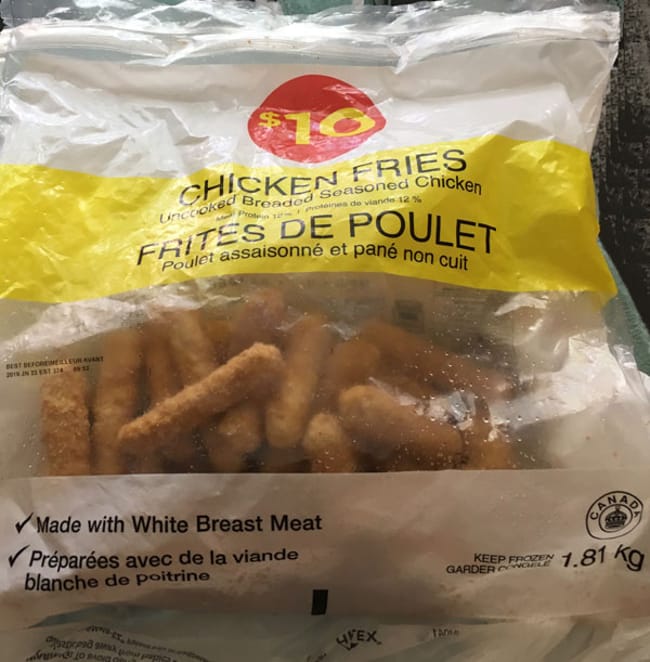
CFIA triggered this recall during its investigation into a foodborne illness outbreak. The CFIA food safety investigation may lead to the recall of other products. If other high-risk products are recalled, the CFIA will notify the public through updated food recall warnings. The agency is verifying that industry is removing recalled product from the marketplace.
On Sept. 13 Canada’s Council of Chief Medical Officers of Health issued a statement advising Canadians to follow proper food safety practices when handling, preparing or consuming frozen raw breaded chicken products such as chicken nuggets, chicken strips, chicken burgers, popcorn chicken and chicken fries.
When not thoroughly cooked, frozen breaded chicken products containing raw chicken pose an increased health risk to individuals who handle, prepare or consume them. These products may appear to be pre-cooked or browned, but they should be handled and prepared with caution. Illnesses can be avoided by following cooking instructions carefully and verifying the internal temperature after cooking, as recommended, before consuming these products. Frozen raw breaded chicken products and raw chicken pieces must be cooked to an internal temperature of at least 74 degrees C (165 degrees F) to ensure that they are safe to eat. Whole chicken needs to be cooked to an internal temperature of 82 degrees C (180 degrees F).
Summary of investigations
In May 2017, Government of Canada scientists began using a new technology called “whole genome sequencing” to help identify and respond to outbreaks. Over the past year and a half, federal, provincial and territorial health and food safety partners have investigated 13 national outbreaks linked to raw chicken, including frozen raw breaded chicken products. The Canadian Food Inspection Agency has issued food recall warnings for eight products linked to some of these outbreak investigations.
The 433 laboratory-confirmed cases of Salmonella infection are in: British Columbia (36), Alberta (64), Saskatchewan (14), Manitoba (20), Ontario (151), Quebec (101), New Brunswick (23), Nova Scotia (9), Prince Edward Island (1), Newfoundland and Labrador (10), Northwest Territories (1), Yukon (1), and Nunavut (2).
There have been 86 individuals hospitalized as part of these outbreaks. Three individuals have died; however, Salmonella was not the cause of death for two of those individuals, and it was not determined whether Salmonella contributed to the cause of death for the third individual. Infections have occurred in Canadians of all ages and genders.
All active and future Salmonella outbreak investigations linked to raw chicken, including frozen raw breaded chicken products, and related food recall warnings will be listed in the next section of the public health notice to remind Canadians of the ongoing risk associated with these types of food products.
Active investigations
Active national Salmonella outbreak investigations linked to raw chicken including frozen raw breaded chicken products, coordinated by the Public Health Agency of Canada:
Oct. 2, 2018, update – Salmonella Enteritidis
- Currently, there are four cases of illness in four provinces linked to this outbreak: Alberta (1), Manitoba (1), Ontario (1) and Quebec (1). No individuals have been hospitalized. No deaths have been reported. Frozen raw breaded chicken products have been identified as the source of this outbreak.
Product recall on Oct. 2, 2018
- $10 Chicken Fries (1.81 kg), with a best-before date of June 22, 2019. UPC – 0 60249 01411 4. The product was distributed nationally.
Oct. 1, 2018, (update) – Salmonella Enteritidis
- Currently, there are 47 cases of illness in eight provinces linked to this outbreak: British Columbia (1), Alberta (7), Saskatchewan (1), Manitoba (2), Ontario (21), Quebec (13), New Brunswick (1), and Nova Scotia (1). Eleven individuals have been hospitalized. No deaths have been reported. Frozen raw breaded chicken products have been identified as the source of this outbreak.
Product recall on July 20, 2018
- No Name brand Chicken Nuggets (907g), with a best before date of May 15, 2019, on the outer package and a lot code of 1358M on the inner package. UPC – 0 60383 89685 0. The product was distributed nationally.
Original notice was July 21, 2018
Canadians are advised not to consume the recalled products, and retailers and restaurants are advised to not sell or serve the recalled products.
Who is most at risk
Anyone can become sick with a Salmonella infection, but infants, children, seniors and those with weakened immune systems are at higher risk of serious illness because their immune systems are more fragile.
Most people who become ill from a Salmonella infection will recover fully after a few days. It is possible for some people to be infected with the bacteria and to not get sick or show any symptoms, but to still be able to spread the infection to others.
(To sign up for a free subscription to Food Safety News, click here.)


