
This week, many will enjoy a delicious meal on Thanksgiving Day with family and friends. Taking the necessary steps toward safe food handling and sanitation will help protect you and your loved ones this year.
With social media abounding in misinformation and confused cooks with strong opinions, the U.S. Department of Agriculture (USDA) has released the following guidelines and answers to common turkey cooking questions to make sure your Thanksgiving meal is prepared safely.
Also, some of your favorite Thanksgiving recipes may include flour, so we’ve included some do’s and don’ts flour safety tips from the FDA.
Clean and Sanitize
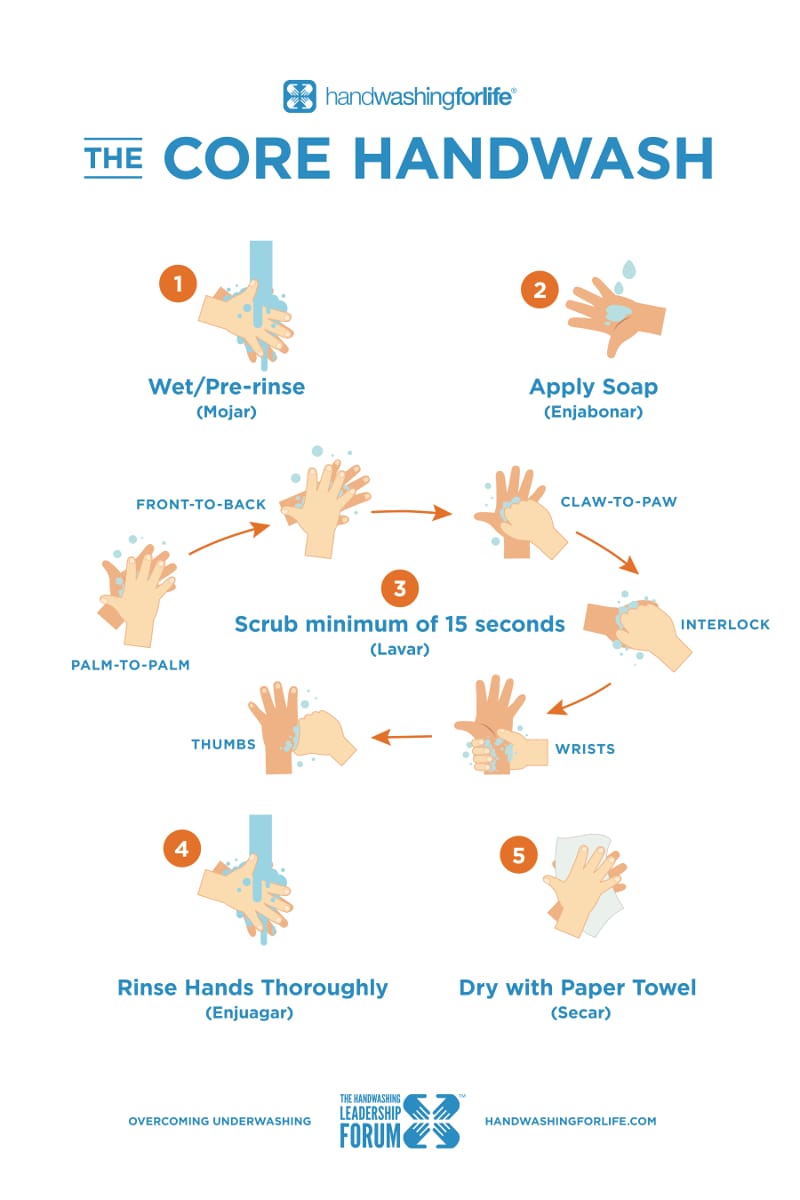
Handwashing is the first step to avoiding foodborne illness. Wash your hands for at least 20 seconds with soap and water before, during, and after handling food. In a recent study, 97 percent of participants in a USDA test kitchen failed to wash their hands properly. Make sure to follow these handwashing steps:
- Wet your hands with clean, running water.
- Lather your fingers with soap.
- Scrub soapy hands and fingers thoroughly for at least 20 seconds. Rinse your hands under clean, running water.
- Dry hands off with a clean towel or air dry them.
Clean and sanitize any surfaces that have touched raw turkey and its juices and will later touch food such as kitchen counters, sinks, stoves, tabletops, etc.
Avoid Cross-Contamination
Cross-contamination is the spread of bacteria from raw meat and poultry onto ready-to-eat food, surfaces, and utensils. One way to avoid this is by using separate cutting boards — one for raw meat and poultry, and another for fruits and vegetables. One USDA study found that sinks are the most contaminated areas of the kitchen. USDA recommends against washing your raw poultry due to the risk of splashing bacteria throughout your kitchen. Clean and sanitize any areas that will come into contact with the turkey before and after cooking.
The Two-Hour Rule
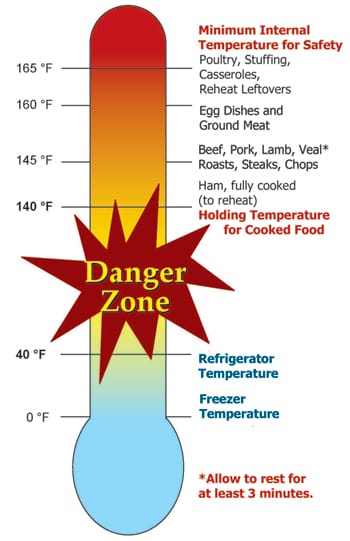
Don’t leave your food sitting out too long! Refrigerate all perishable foods sitting out at room temperature within two hours of being cooked, or one hour if the temperature is 90 F or above. After two hours, perishable food will enter the “Danger Zone” (between 40 F and 140 F), which is where bacteria can multiply quickly and cause the food to become unsafe. Discard all foods that have been left out for more than two hours. Remember the rule — keep hot foods hot and cold foods cold.
- Transporting hot foods — Wrap dishes in insulated containers to keep their temperature above 140 F.
- Transporting cold foods — Place items in a cooler with ice or gel packs to keep them at or below 40 F.
When serving food to groups, keep hot food hot and keep cold food cold by using chafing dishes or crock pots and ice trays. Hot items should remain above 140 F and cold items should remain below 40 F.
Stuffing your Turkey
USDA recommends against stuffing your turkey since this often leads to bacteria growth. However, if you plan to stuff your turkey, follow these steps:
- Prepare the wet and dry ingredients for the stuffing separately from each other and refrigerate until ready to use. Mix wet and dry ingredients just before filling the bird’s cavity.
- Do not stuff whole poultry and leave in the refrigerator before cooking.
- Stuff the turkey loosely — about 3/4 cup of stuffing per pound.
- Immediately place the stuffed, raw turkey in an oven set no lower than 325 F.
- A stuffed turkey will take longer to cook. Once it has finished cooking, place a food thermometer in the center of the stuffing to ensure it has reached a safe internal temperature of 165 F.
- Let the cooked turkey stand 20 minutes before removing the stuffing.
A guide to safely roasting turkey
Fresh turkeys:
- Allow 1 pound of turkey per person.
- Buy your turkey only 1 to 2 days before you plan to cook it.
- Keep it stored in the refrigerator until you’re ready to cook it. Place it on a tray or in a pan to catch any juices that may leak.
- Do not buy fresh pre-stuffed turkeys. If not handled properly, any harmful bacteria that may be in the stuffing can multiply very quickly.
Frozen turkeys:
- Allow 1 pound of turkey per person.
- Keep frozen until you’re ready to thaw it.
- Turkeys can be kept frozen in the freezer indefinitely; however, cook within 1 year for best quality.
Frozen pre-stuffed turkeys:
USDA recommends only buying frozen pre-stuffed turkeys that display the USDA or State mark of inspection on the packaging. These turkeys are safe because they have been processed under controlled conditions.
Do not thaw before cooking. Cook from the frozen state. Follow package directions for proper handling and cooking.
Allow 1¼ pounds of turkey per person.
Thawing your turkey
There are three ways to thaw your turkey safely — in the refrigerator, in cold water, or in the microwave oven.
In the refrigerator (40 °F or below):
Allow approximately 24 hours for every 4 to 5 pounds
- 4 to 12 pounds1 to 3 days
- 12 to 16 pounds3 to 4 days
- 16 to 20 pounds4 to 5 days
- 20 to 24 pounds5 to 6 days
Keep the turkey in its original wrapper. Place it on a tray or in a pan to catch any juices that may leak. A thawed turkey can remain in the refrigerator for 1 to 2 days. If necessary, a turkey that has been properly thawed in the refrigerator may be refrozen.
In Cold Water:
Allow approximately 30 minutes per pound
- 4 to 12 pounds2 to 6 hours
- 12 to 16 pounds6 to 8 hours
- 16 to 20 pounds8 to 10 hours
- 20 to 24 pounds10 to 12 hours
Wrap your turkey securely, making sure the water is not able to leak through the wrapping. Submerge your wrapped turkey in cold tap water. Change the water every 30 minutes. Cook the turkey immediately after it is thawed. Do not refreeze.
In the Microwave Oven:
- Check your owner’s manual for the size turkey that will fit in your microwave oven, the minutes per pound, and power level to use for thawing.
- Remove all outside wrapping.
- Place on a microwave-safe dish to catch any juices that may leak.
- Cook your turkey immediately. Do not refreeze or refrigerate your turkey after thawing in the microwave oven.
Remove the giblets from the turkey cavities after thawing. Cook separately.
Roasting Your Turkey
- Set your oven temperature no lower than 325 °F.
- Place your turkey or turkey breast on a rack in a shallow roasting pan.
For optimum safety, stuffing a turkey is not recommended. For more even cooking, it is recommended you cook your stuffing outside the bird in a casserole. Use a food thermometer to check the internal temperature of the stuffing. The stuffing must reach a safe minimum internal temperature of 165 °F. - If you choose to stuff your turkey, the ingredients can be prepared ahead of time; however, keep wet and dry ingredients separate. Chill all of the wet ingredients (butter/margarine, cooked celery and onions, broth, etc.). Mix wet and dry ingredients just before filling the turkey cavities. Fill the cavities loosely. Cook the turkey immediately. Use a food thermometer to make sure the center of the stuffing reaches a safe minimum internal temperature of 165 °F.
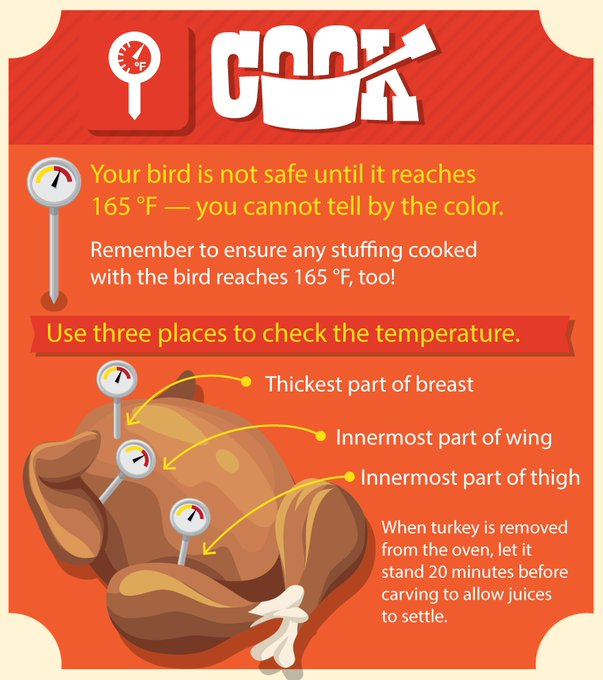
- A whole turkey is safe when cooked to a minimum internal temperature of 165 °F, as measured with a food thermometer. Check the internal temperature in the innermost part of the thigh and wing and the thickest part of the breast. For reasons of personal preference, consumers may choose to cook turkey to higher temperatures.
- If your turkey has a “pop-up” temperature indicator, it is recommended that you also check the internal temperature of the turkey in the innermost part of the thigh and wing and the thickest part of the breast with a food thermometer. The minimum internal temperature should reach 165 °F for safety.
- For quality, let the turkey stand for 20 minutes before carving to allow juices to set. The turkey will carve more easily.
- Remove all stuffing from the turkey cavities.
Timetables for turkey roasting
(325 °F oven temperature)
Use the timetables below to determine how long to cook your turkey. These times are approximate. Always use a food thermometer to check the internal temperature of your turkey and stuffing.
Unstuffed:
- 4 to 8 pounds (breast)1½ to 3¼ hours
- 8 to 12 pounds2¾ to 3 hours
- 12 to 14 pounds3 to 3¾ hours
- 14 to 18 pounds3¾ to 4¼ hours
- 18 to 20 pounds4¼ to 4½ hours
- 20 to 24 pounds4½ to 5 hours
Stuffed:
- 4 to 6 pounds (breast)Not usually applicable
- 6 to 8 pounds (breast)2½ to 3½ hours
- 8 to 12 pounds3 to 3½ hours
- 12 to 14 pounds3½ to 4 hours
- 14 to 18 pounds4 to 4¼ hours
- 18 to 20 pounds4¼ to 4¾ hours
- 20 to 24 pounds4¾ to 5¼ hours
It is safe to cook a turkey from the frozen state. The cooking time will take at least 50 percent longer than recommended for a fully thawed turkey. Remember to remove the giblet packages during the cooking time. Remove carefully with tongs or a fork.
Optional Cooking Hints
- Tuck wing tips under the shoulders of the bird for more even cooking. This is referred to as “akimbo.”
- Add ½ cup of water to the bottom of the pan.
- If your roasting pan does not have a lid, you may place a tent of heavy-duty aluminum foil over the turkey for the first 1 to 1 ½ hours. This allows for maximum heat circulation, keeps the turkey moist, and reduces oven splatter. To prevent overbrowning, foil may also be placed over the turkey after it reaches the desired color.
- If using an oven-proof food thermometer, place it in the turkey at the start of the cooking cycle. It will allow you to check the internal temperature of the turkey while it is cooking. For turkey breasts, place thermometer in the thickest part. For whole turkeys, place in the thickest part of the inner thigh. Once the thigh has reached 165 °F, check the wing and the thickest part of the breast to ensure the turkey has reached a safe minimum internal temperature of 165 °F throughout the product.
- If using an oven cooking bag, follow the manufacturer’s guidelines on the package.
Remember to immediately wash hands, utensils, the sink, and anything else that comes in contact with raw turkey and its juices with soap and water.
Storing Your Leftovers
- Discard any turkey, stuffing, and gravy left out at room temperature longer than 2 hours; 1 hour in temperatures above 90 °F.
- Divide leftovers into smaller portions. Refrigerate or freeze in covered shallow containers for quicker cooling.
- Use refrigerated turkey, stuffing, and gravy within 3 to 4 days.
- If freezing leftovers, use within 2 to 6 months for best quality.
Reheating Your Turkey
Cooked turkey may be eaten cold or reheated.
In the Oven:
- Set the oven temperature no lower than 325 °F.
- Reheat turkey to an internal temperature of 165 °F. Use a food thermometer to check the internal temperature.
- To keep the turkey moist, add a little broth or water and cover.
In the Microwave Oven:
- Cover your food and rotate it for even heating. Allow standing time.
- Check the internal temperature of your food with a food thermometer to make sure it reaches 165 °F.
- Consult your microwave oven owner’s manual for recommended times and power levels.
USDA Hotline
The USDA Meat and Poultry Hotline will be open on Thanksgiving Day from 8 a.m.-2 p.m. ET. Consumers with questions can call 1-888-MPHotline (1-888-674-6854), chat live or email MPHotline@usda.gov.
Services are available in English and Spanish. Leading up to the holiday, customer service representatives on the hotline will be available during regular hours: 10 a.m.-6 p.m. ET, Monday through Friday.
Flour Safety, Do’s and Don’ts from the FDA
Do’s:
- Follow directions on baking mix packages and other flour-containing products for the correct cooking times and optimal cooking temperature.
- Keep flour separated from ready-to-eat foods to avoid accidentally consuming raw flour.
- Refrigerate cookie and pastry dough as stated by their package directions. Use a refrigerator thermometer to ensure your appliance is at a safe temperature of 40°F or below for raw food storage.
- Thoroughly clean your hands with soap and running water after handling raw flour and foods that contain raw flour. Also, clean your cooking utensils, countertops, and supplies (bowls, baking pans, cutting boards, etc.) with warm, soapy water.
Don’ts:
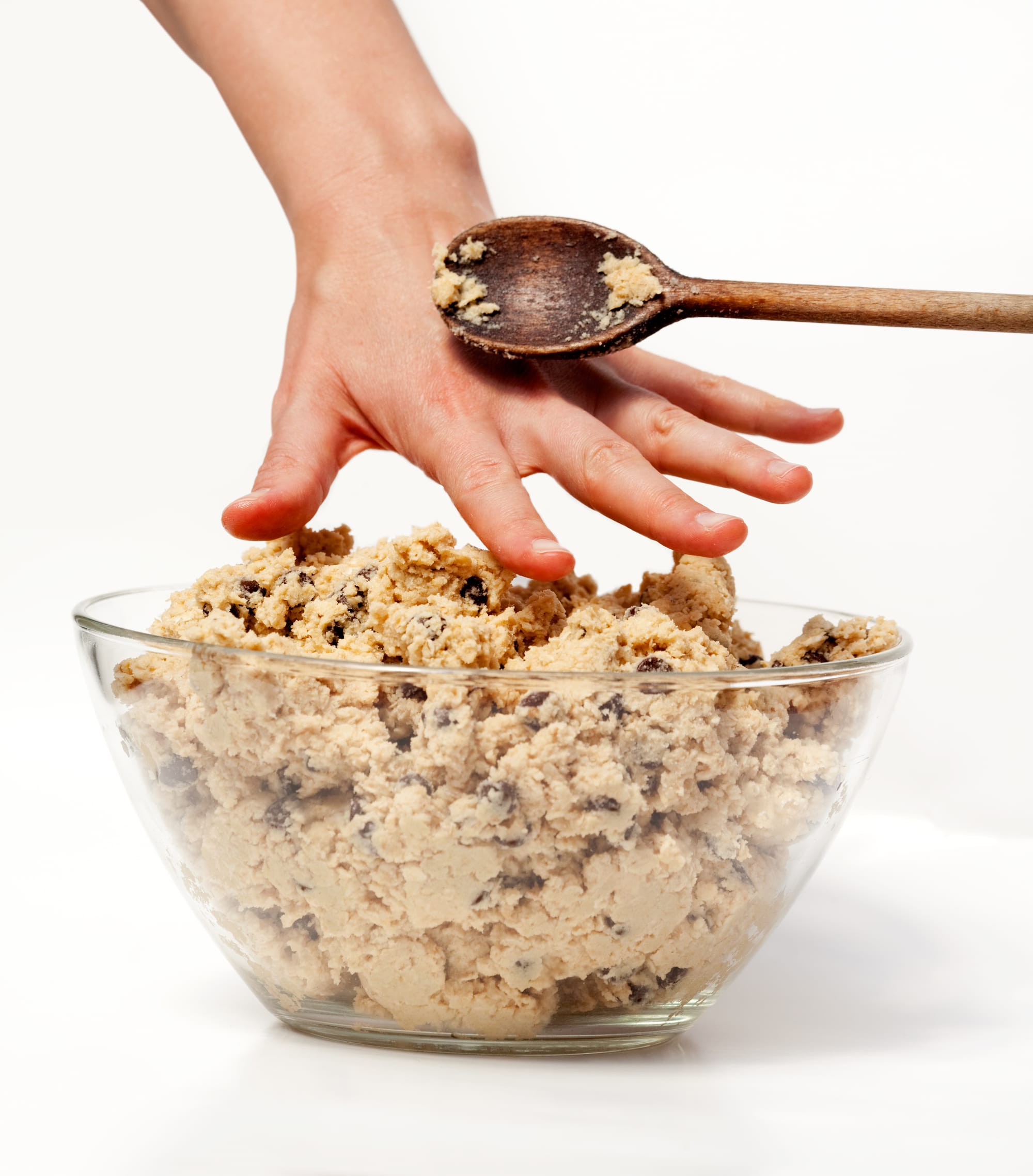
- Don’t eat or taste raw dough products or baking mix. The flour within the food products may contain bacteria that could make you sick.
- Don’t allow raw dough products to be used as crafts or play clay. Young children often put their hands in their mouths, which could introduce harmful bacteria from raw dough into their bodies and make them sick.
- Don’t use products that contain raw flour, like cake mix or raw batter, to make or consume ready-to-eat products, like milkshakes or ice cream.
(To sign up for a free subscription to Food Safety News, click here)


