
The FDA is reporting that the nation’s supply of infant formula is safe after the “most rigorous examination” of products ever undertaken.
The testing program did not include foodborne pathogens such as Cronobacter, Listeria, Salmonella and E. coli. The agency tested for arsenic, cadmium, lead, mercury, 30 PFAS, 318 pesticides, 21 phthalates, and 1 non-phthalate Plasticizer.
The investigation was part of Operation Stork Speed, which the Food and Drug Administration launched in 2025 to ensure the safety of infant formula. The action was in response to a cronobacter outbreak in 2022.
“We tested more infant formula than ever before, and the results are clear: most products meet a high safety standard — but even small exposures matter for newborns,” said Health and Human Services Secretary Robert F. Kennedy Jr.
The testing found “an overwhelming majority of samples had undetectable or very low levels of contaminants, affirming that the U.S. infant formula supply is safe,” according to the FDA’s report.
However, the United States doesn’t have a legal limit for any of the metals in infant formula the FDA tested for. Consequently, when the FDA calls formula “safe,” there is no standard behind that word.
Operation Stork Speed is also looking into the nation’s supply of infant formula, which was greatly depleted after a recall by Abbott Nutrition in the wake of the cronobacter outbreak.
“We’re doing everything in our power to make sure our babies and infants have safe, high-quality formula options that are backed by a resilient supply chain,” said FDA Commissioner Marty Makary.
The FDA tested 312 samples from 16 brands, but did not say in its report what brands it tested. Formula types tested were: powdered with 278 samples; 11 of concentrated liquid; and 23 ready to feed liquid. The protein sources included in the sampled were 258 cow’s milk, 44 soy and 10 amino acid-based.
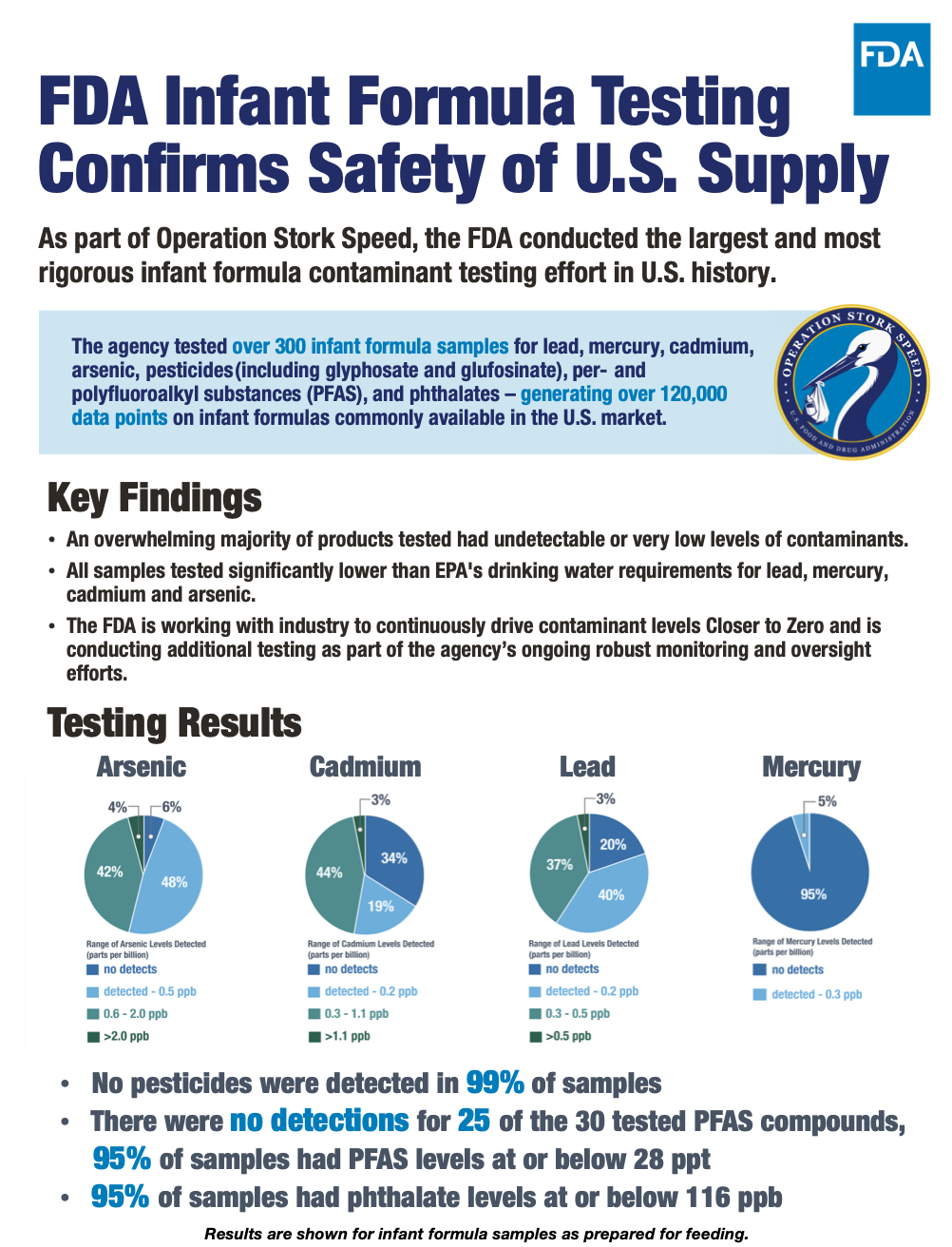
“Across the products tested, the majority of infant formula samples had undetectable or very low levels of contaminants, affirming the safety of the U.S. infant formula supply,” according to the FDA’s report.
“While contaminant levels were low, some samples had values that have initiated additional follow-up actions as a part of the agency’s robust monitoring and oversight efforts. This will include conducting further testing and continuing to engage with manufacturers on measures to reduce contaminant levels to as low as possible.”
For each contaminant FDA reported the following values illustrate typical levels measured:
- Not detected: The amount, if present, was too small for our testing methods to detect
- Range: The lowest to highest levels (concentrations) detected
- 95th percentile (reported as 95 percent): The level below which 95 percent of samples fell (meaning only 5 percent of samples were higher)
- Median: The midpoint in a set of data when the numbers are put in order from lowest to highest. It helps show a common number in the group.
- Parts per billion (ppb): One part per billion is equivalent to one drop of water in an Olympic-size swimming pool
The test results were as follows:
- Mercury was not detected in 296 out of 312 samples (95 percent). Among all samples, concentrations ranged from not detected to 0.3 ppb. Given the high number of non-detects, a 95th percentile and median were not calculated.
- Cadmium was not detected in 106 out of 312 samples (34 percent). Among all samples, concentrations ranged from not detected to 1.5 ppb. 95 percent of all samples had less than 1.1 ppb of cadmium. The median cadmium concentration was 0.2 ppb.
- Lead was not detected in 61 out of 312 samples (20%). Among all samples, concentrations ranged from not detected to 1.1 ppb, with 95% of samples containing less than 0.5 ppb of lead. The median lead concentration was 0.2 ppb.
- Arsenic was not detected in 18 out of 312 samples (6 percent). Among all samples, concentrations ranged from not detected to 4.7 ppb. 95 percent of all samples had less than 2.0 ppb of arsenic. The median arsenic concentration was 0.5 ppb.
- Pesticides: Each of the samples were tested for 318 different pesticides, including glyphosate and glufosinate. 309 samples (99 percent) had no detectable pesticides, and glyphosate and glufosinate were not detected in any samples. Given the high number of non-detects, a 95th percentile and median were not calculated. Only three samples had detectable pesticide levels, all at very low concentrations: 0.25 ppb chlorpyrifos in one sample, 0.20 ppb malathion in another sample, and 0.20 ppb piperonyl butoxide in a third sample.
- PFAS: Each of the samples were tested for 30 different PFAS compounds. Most PFAS compounds (25 of 30) were not found in any samples. Five PFAS were detected in a subset of samples at concentrations ranging from 0.51 ppt to 150 ppt, depending on the compound. The most commonly detected was Perfluorooctanesulfonic acid (PFOS), found in half of samples at detectable concentrations ranging from 0.51 to 6.0 ppt, with 95 percent of all samples containing less than 2.9 ppt of PFOS. Given the high number of non-detects, the median was not calculated. PFAS levels are often reported in parts per trillion (ppt) because testing methods can detect these contaminants at extremely low concentrations. One part per trillion is equivalent to one second in 32,000 years, or one drop in 1,000 Olympic-size swimming pools.
- Phthalates: Each of the samples were tested for 21 phthalates and 1 non-phthalate plasticizer. Phthalates were not detected in 167 out of 312 samples (54 percent). Among the compounds tested. Seven phthalates were not detected in any samples. Five phthalates were rarely detected (in fewer than 2 percent of samples). The remaining compounds that were detected had concentrations ranging from not detected to 145 ppb.The most commonly detected phthalate compounds were DEHP and DINP:
- DEHP was not detected in 253 out of 312 samples (81 percent). Among the samples, DEHP concentrations ranged from not detected to 57 ppb. Given the high number of non-detects, a 95th percentile and median were not calculated. DINP was not detected in 260 out 312 samples (83 percent). Among the samples, DINP concentrations ranged from not detected to 145 ppb. Given the high number of non-detects, a 95th percentile and median were not calculated.
- Human milk: While this phase of testing focused specifically on infant formula products, the FDA also tested a limited number (110) of human milk samples from a single state donor human milk bank for arsenic, cadmium, mercury, and lead. Overall, the majority of samples (85 percent) had at least one detectable contaminant, while 17 samples (15 percent) had no detects of any of the contaminants. Mercury demonstrated the highest detection rate at 61 percent, followed by cadmium at 57 percent, arsenic at 33 percent, and lead at 30 percent.


