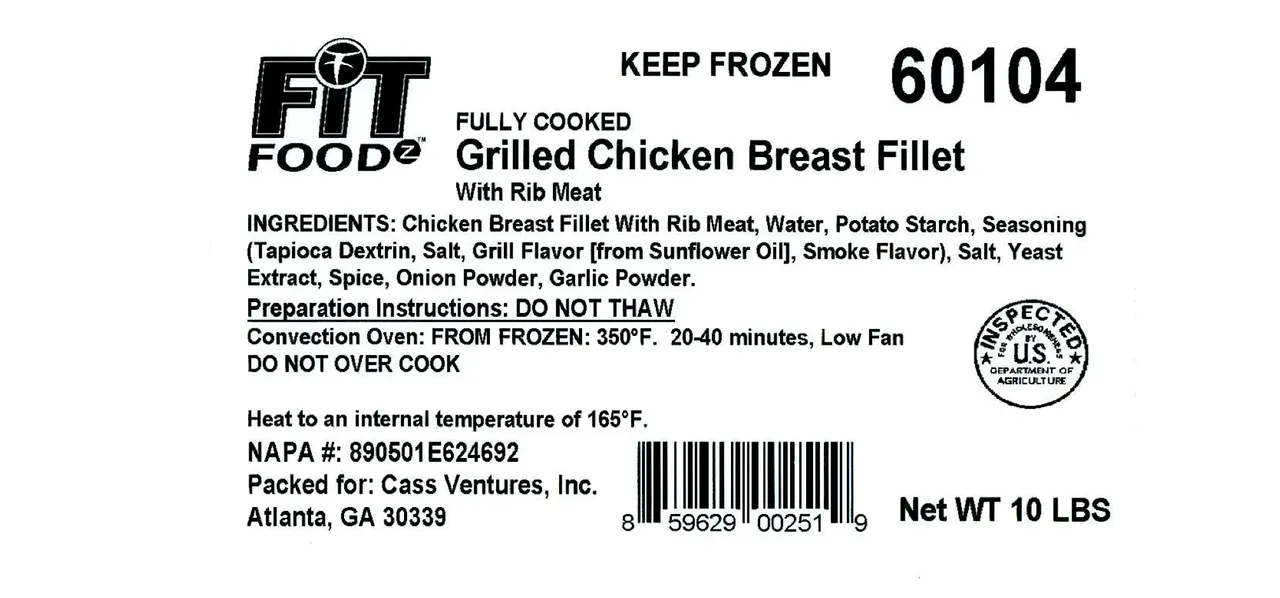
Suzanna’s Kitchen of Norcross, GA, is recalling 13,720 pounds of ready- to-eat grilled chicken breast fillet products that may be contaminated with Listeria monocytogenes, the USDA’s Food Safety and Inspection Service (FSIS) announced.
The ready-to-eat grilled chicken breast fillet items were produced on Oct. 14, 2025. The following products is subject to recall:
- 10-lb. cases containing two 5 lb. bags of fully cooked grilled chicken breast fillets with rib meat, with lot code 60104 P1382 287 5 J14 on the side of the case and on the package.
The products subject to recall have the establishment number P-1382 printed inside the USDA mark of inspection.
These items were shipped to distribution centers for foodservice sales in Alabama, Florida, Georgia, Missouri, New Hampshire, North Carolina, and Ohio.
The problem was discovered when a third-party laboratory sample reported a positive Listeria monocytogenes result in the ready-to-eat fully cooked grilled chicken breast fillets product.
There have been no confirmed reports of illness related to consumption of these products.
About Listeria infections
Food contaminated with Listeria monocytogenes may not look, smell or taste spoiled but can still cause serious and sometimes life-threatening infections. Anyone who has eaten any recalled the recalled chicken nd developed symptoms of Listeria infection should seek medical treatment and tell their doctors about the possible Listeria exposure.
Also, anyone who has eaten any of the recalled products should monitor themselves for symptoms during the coming weeks because it can take up to 70 days after exposure to Listeria for symptoms of listeriosis to develop.
Symptoms of Listeria infection can include vomiting, nausea, persistent fever, muscle aches, severe headache, and neck stiffness. Specific laboratory tests are required to diagnose Listeria infections, which can mimic other illnesses.
Pregnant women, the elderly, young children, and people such as cancer patients who have weakened immune systems are particularly at risk of serious illnesses, life-threatening infections, other complications and death. Although infected pregnant women may experience only mild, flu-like symptoms, their infections can lead to premature delivery, infection of the newborn, or even stillbirth.


