
The CDC is reporting that almost 7,000 people nationwide are part of several outbreaks of infections from the microscopic cyclospora parasite.
The foodborne parasite has infected people in 34 states according to a July 14 report from the Centers for Disease Control and Prevention. The agency had previously been reporting 843 confirmed patients. Now the CDC is reporting that there are 5,100 more suspected patients. By this time in 2025 the CDC had counted 249 confirmed patients.
This year's case count "is a much higher number than we typically see in a cyclosporiasis season," Gwen Biggerstaff, deputy director of CDC's Division of Foodborne, Waterborne, and Environmental Diseases said during a media briefing Tuesday. "It's a very big shift from what we've seen in previous seasons."
The broader rise in confirmed cases across 34 states points to more than one outbreak, said Donald Prater, DVM, the FDA's acting Deputy Commissioner for Food, during the briefing. "I think we're looking at multiple clusters and subclusters."
The FDA is aware of a "signal" pointing to lettuce as a possible outbreak source in Michigan, said. "We're continuing to trace multiple items, including lettuce."
State officials in Michigan reported on July 14 that the count in their state is 3,309 confirmed patients. Those state officials reported on July 13 that they believe lettuce and/or salad mixes are the source of the parasite, but they said there is no single grower, supplier or brand identified yet.
New York and Ohio are each reporting several hundred confirmed patients.
The CDC’s counting has been hampered by the fact that the agency stopped tracking cyclospora infections beginning July 1 in 2025.
This year's count comes a year after program cuts led by Health and Human Services Secretary Robert F. Kennedy Jr. prompted the CDC to remove the microscopic parasite Cyclospora from a list of eight pathogens that states were mandated to report to the Foodborne Diseases Active Surveillance Network, or FoodNet. As of July 2025, reporting is optional for all pathogens except Salmonella and Shiga toxin-producing E. coli.
“For weeks the distance between what the states were counting and what Atlanta was publishing was the whole story; this week the agency finally revised upward, pushed the alert to every clinician and lab in the country, and named the outbreak. That is what a functioning surveillance system is supposed to do,” said food safety expert and attorney Bill Marler.
For the patients confirmed so far by the CDC, the ages range from 2 to 95 years, with a median age of 44 years, and 56 percent were female. Of 1,645 case-patients with information available, 141 (9 percent) were hospitalized. No deaths have been reported.
Taco Bell restaurants in the Detroit, MI, area have posted signs that they have stopped serving lettuce and other fresh produce items because of a recall, but no recall has been issued. Some of the Michigan outbreak patients have reported eating at Taco Bell before becoming ill, but many have not.
CNN is reporting that an internal email message at the CDC said the Food and Drug Administration’s Coordinated Outbreak Response and Evaluation network is running traceback on cilantro, white and green onions, and cucumbers for a different set of cases — in Illinois, New York City, New York State, Pennsylvania, and Texas — that appear to be linked to Mexican-style restaurants, a grocery chain and a catered event.
The incubation period for cyclospora infection to begin to cause symptoms is up to two weeks after exposure. Symptoms can last a month of more.
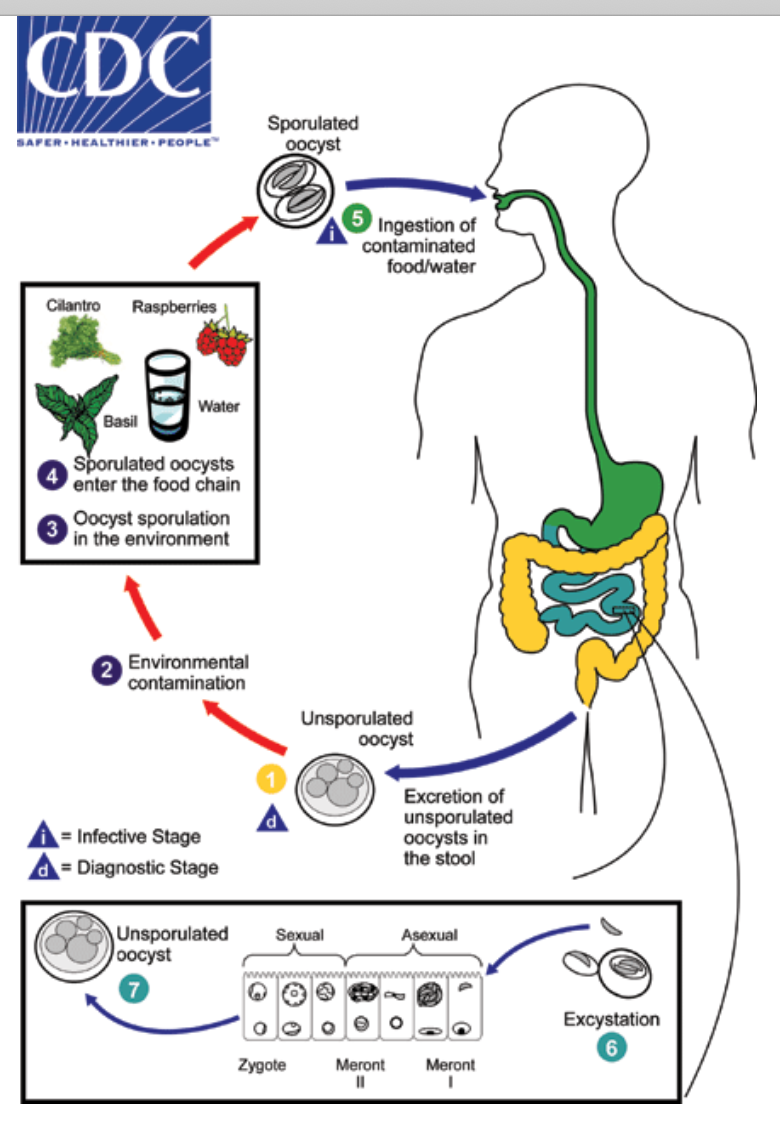
Michigan officials said because of complex food distribution networks across the state and country, it will take some time for agencies to complete their investigation.
“Recreational water exposure, such as swimming in lakes, is not a recognized risk factor for cyclosporiasis and there is currently no evidence linking recreational water activities to this outbreak,” according to the Michigan Department of health.
“While people should always avoid swallowing recreational water, foodborne exposure – particularly exposure to contaminated produce – remains the primary focus of this outbreak investigation.”
Anyone who has developed symptoms of Cyclospora infection, and has reason to believe they have been exposed to the parasite, should seek medical attention. Specific tests are required and antibiotics are used to fight the parasite.
Cyclospora infection can cause severe abdominal pain, severe watery diarrhea, nausea, vomiting, body aches, and fatigue. Symptoms can develop between two and 14 days after exposure. Without treatment, symptoms can last a month or longer.


