
-- OPINION --
Much has been written about the impact of Upton Sinclair’s 1906 novel The Jungle, but the more revealing parallel may be what followed. After President Theodore Roosevelt sent investigators to verify Sinclair’s claims, their findings confirmed systemic problems. The response was not immediate accountability. It was resistance.
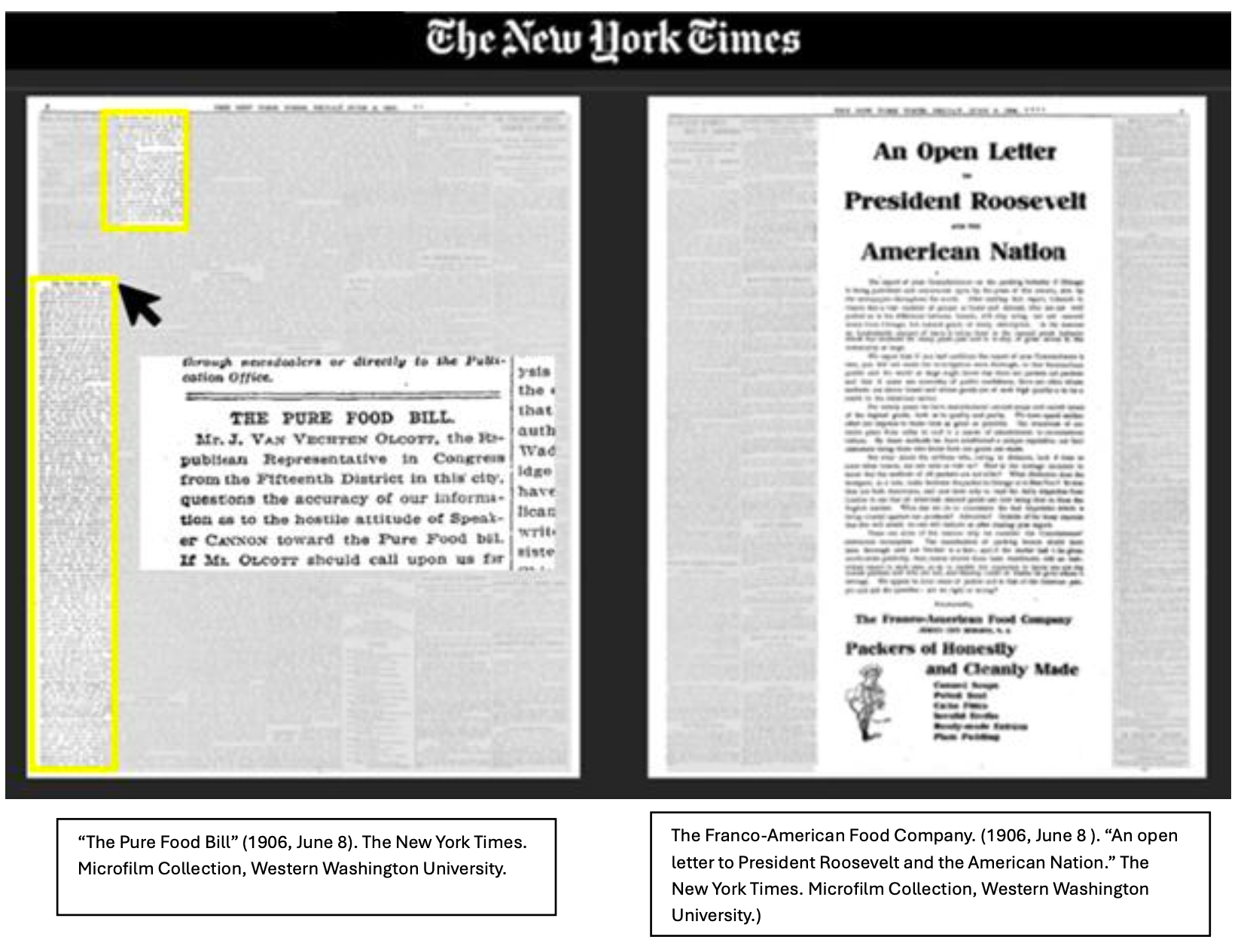
On June 8, 1906, the New York Times reported on Congressional action toward what would become the Pure Food and Drug Act. On that same day, the Franco-American Food Company purchased a prominent, nearly full-page advertisement positioned opposite coverage of the proposed law, visually reinforcing its response.
The advertisement, titled “An Open Letter to President Roosevelt and the American Nation,” was presented as a direct appeal to both the President and the public: They described themselves as the “Packers of Honestly and Cleanly Made” products and then made a plea to the president:
“The report of your Commissioners on the packing industry of Chicago is being published and commented upon by the press of this country, also by the newspapers throughout the world. After reading that report, it stands to reason that a vast number of people at home and abroad, who are not well posted as to the difference between brands, will stop using, not only canned meats from Chicago, but canned goods of every description.
"We regret that if you feel confident the report of your Commissioners is true, you did not make the investigation more thorough, so that the American public and the world at large might know that there are packers and packers and that if some are unworthy of public confidence, there are others whose methods are above board and whose goods are of such high quality as to be a credit to the American nation. For twenty years we have manufactured canned soups and canned meats of the highest grade, both as to quality and purity. We have spared neither effort or expense to make them as good as possible. The cleanliness of our entire plant from cellar to roof is a matter of astonishment to our numerous visitors. By these methods we have established a unique reputation, our best customers being those who know how our goods are made.
"But what about the millions who, owing to distance, lack of time or some other reason, are not able to visit us? How is the average consumer to know that the methods of all packers are not alike? … What can we do to counteract the bad impression which is being created against our products? Advertise? Outside of the heavy expense that this will entail, no one will believe us after reading your report."
More than a century later, the language has changed. The strategy has not.
Their concern was not denial of risk - but differentiation: If some producers were unsafe, others, they argued, should not be judged the same. They posed a critical question:How can consumers distinguish between responsible producers and those who put them at risk?
And perhaps more tellingly: What can we do to counteract the damage to our reputation?
Their conclusion was revealing – advertising alone would not restore trust once it had been broken.
The pattern is familiar:
1. Evidence emerges
2. Public health risk is identified
3. Industry disputes the findings
4. Action is delayed
Sound familiar?
Today, Raw Farm LLC denies the FDA’s conclusions, citing its own negative test results despite epidemiological and traceback evidence linking its product to illness.
The tools have evolved. The science is stronger. But the behavior has not changed.
The FDA has linked an outbreak of E. coli infections to raw cheddar cheese produced by Raw Farm, sickening at least seven people across three states, including young children. Health officials are urging consumers to discard affected products. Raw Farm, the largest producer of raw, unpasteurized dairy products in the United States, has declined to initiate a voluntary recall.
When epidemiological data, traceback investigations, and microbial testing align, the agency’s confidence and willingness to escalate increase significantly. In this case, the FDA has determined the cheese to be the likely source of the outbreak.
The congressional Food Safety Caucus has called on the FDA to exercise its authority and compel a recall, emphasizing that when a company refuses voluntary action, the responsibility to protect public health shifts decisively to the regulator.
According to the caucus, “The FDA recommended that Raw Farm voluntarily remove its raw cheese products from sale after they determined it was the likely source of an ongoing E. coli outbreak… Raw Farm refused. We have one message for Raw Farm and FDA: get it off the shelves – now.”
They further emphasized the severity of the outbreak, particularly its impact on young children:
“Two people have been hospitalized because of this outbreak, with several more falling ill.
"More than half of the illnesses were in children aged 3 or younger. This cannot stand. If Raw Farm refuses to take unsafe products off the market, FDA must use its mandatory recall authority and take them to court. A company should not be able to flatly refuse a recall recommendation. That puts consumers’ health at risk to protect the profits of a corporation.”
“FDA must act so consumers are not subject to the whims of corporations that would put their profits over public health.”
The CDC has urged consumers to avoid Raw Farm cheese products.
Under the Food Safety Modernization Act, the FDA has the authority to issue a mandatory recall when there is a reasonable probability that a product will cause serious adverse health consequences and the firm refuses voluntary action. That authority has been used before, including in 2018 when the agency ordered a recall of kratom products contaminated with Salmonella after a company declined to act. If the evidence meets that threshold, the FDA not only can act, it should. The question is whether that action will come before more people are harmed.
About the author: Dr. Darin Detwiler is a food safety advocate, author, and professor of food policy and law. A former USDA advisor and FDA collaborator on the implementation of the Food Safety Modernization Act, he has spent more than three decades working to strengthen food safety systems following the 1993 E. coli outbreak that took the life of his young son. He is the author of Food Safety: Past, Present, and Predictions and a recognized voice on issues of public health, regulation, and accountability. Detwiler is featured in the Emmy Award-winning 2023 Netflix documentary Poisoned: The Dirty Truth About Your Food.


